
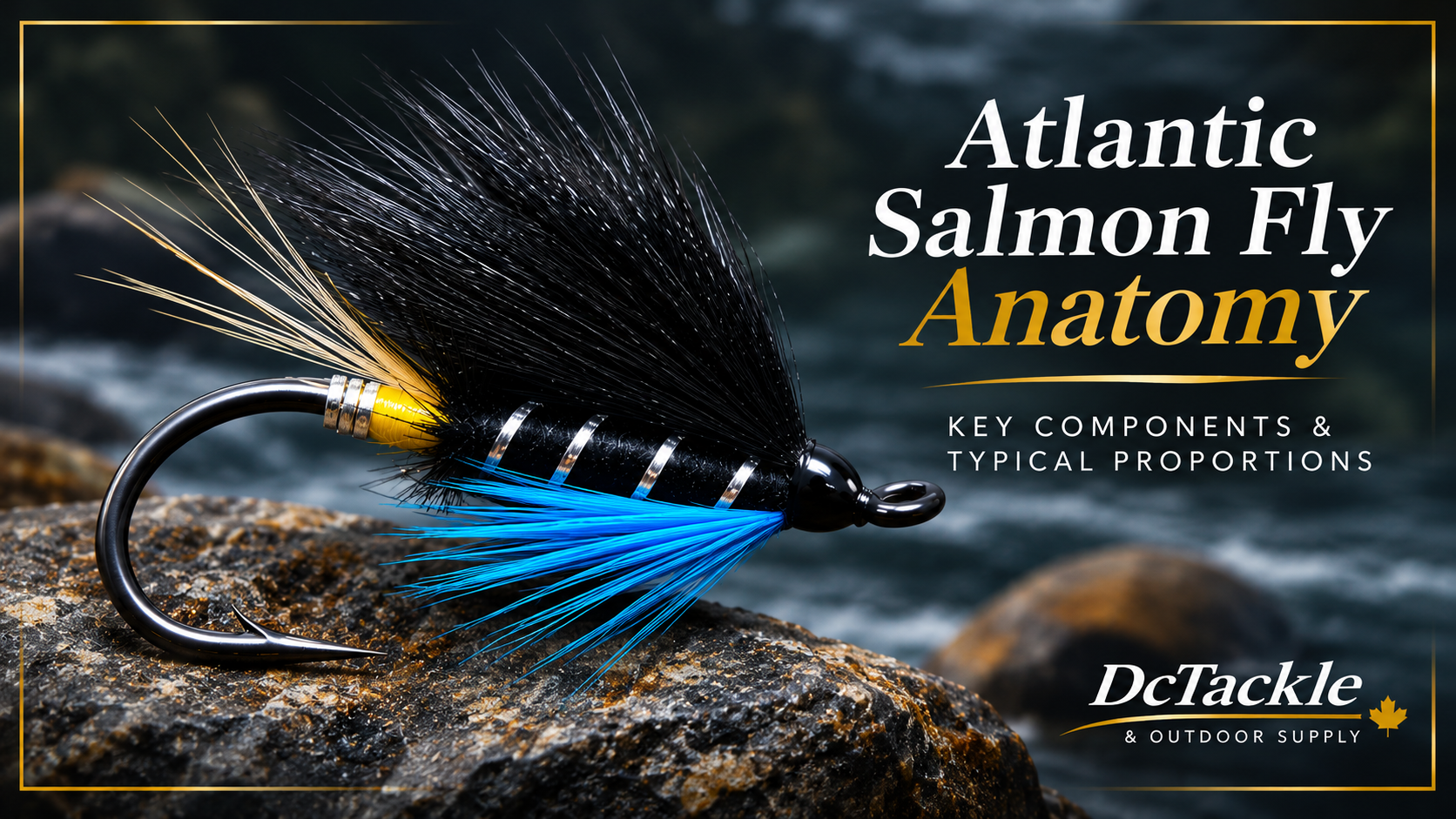
Understanding the Components of a Traditional Atlantic Salmon Wet Fly
Traditional Atlantic salmon wet flies are recognized for their distinctive profiles, carefully selected materials, and balanced proportions. Although individual patterns vary considerably in colour, materials, and construction, many share a common arrangement of components that contribute to the overall appearance of the finished fly.
Understanding these components and their relative proportions is an important part of developing consistent fly-tying skills. From the positioning of the tip and tag to the length of the wing and the finishing of the head, each element contributes to the overall balance and presentation of the pattern.
In this guide, I'll examine the nine principal components of a traditional Atlantic salmon wet fly, using practical proportional guidelines and construction preferences developed through my own tying experience at DcTackle & Outdoor Supply.
An Important Note on Proportions
The measurements and proportions discussed throughout this guide are intended as practical guidelines rather than rigid rules. Traditional tying practices vary among fly tiers, hook styles, and individual patterns.
Where appropriate, I've also included my own DcTackle construction preferences. These reflect the methods and proportions I favour when tying salmon flies and should be viewed as personal interpretations rather than universal standards.
The accompanying infographic illustrates the nine components using the DcTackle Blue Charm — Dark Wing (SW-001) as a reference pattern.
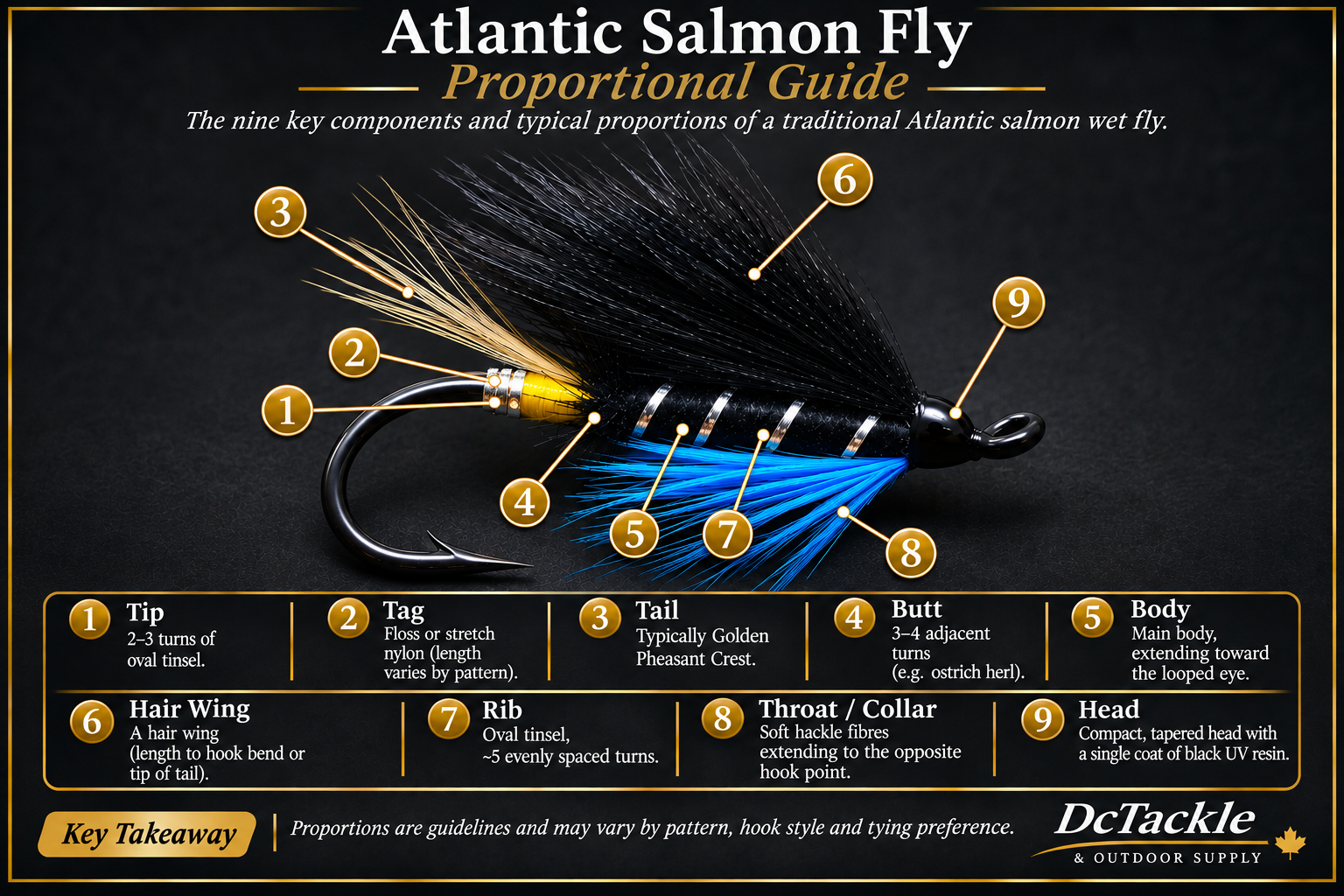
1–2. Tip / Tag Assembly
The terms tip and tag are sometimes used interchangeably when describing the rear components of a traditional Atlantic salmon wet fly. For consistency throughout this guide, the tip refers to the oval tinsel, while the tag refers to the floss or stretch nylon immediately ahead of it.
Traditional Proportions
The tip typically consists of 2–3 closely spaced turns of oval tinsel, positioned approximately above the hook barb.
The tag is formed with floss or stretch nylon, beginning immediately ahead of the tip and extending forward to approximately the position opposite the hook point.
The size of the oval tinsel should be selected in proportion to the hook size, with finer tinsel generally suited to smaller hooks and heavier tinsel to larger hooks.
DcTackle Construction Preference
For my own flies, I use a slightly different approach. I begin the oval tinsel just behind the position opposite the hook point and make 2–3 turns forward, finishing approximately above the hook point.
I then form the floss or stretch nylon tag immediately ahead of the tinsel, extending it forward approximately one hook-eye length.
This is a personal construction preference rather than a strict traditional requirement. I find that it produces a more balanced and visually pleasing proportion in my finished salmon flies.
The exact length is somewhat subjective and may be adjusted slightly to suit the hook style, size, and overall proportions of the fly.
3. Tail
The tail of a traditional Atlantic salmon wet fly typically extends rearward to approximately the end of the hook bend.
Many traditional salmon fly patterns feature a Golden Pheasant Crest feather for the tail. The feather's natural upward curve should complement the downward curve of the hook bend, creating a balanced, symmetrical appearance.
The overall tail length and curvature may be adjusted slightly to suit the hook style and proportions of the finished fly.
4. Butt
The butt is typically formed using 3–4 closely spaced turns of ostrich herl, wrapped forward along the hook shank toward the eye.
The finished width is determined by the number of adjacent turns, producing a compact, evenly shaped section immediately ahead of the tail and tag assembly.
Materials and proportions may vary according to the individual pattern recipe.
5. Body
The body of a traditional Atlantic salmon wet fly is commonly constructed using floss or tinsel, although the materials and construction methods vary according to the individual pattern recipe.
The body typically extends forward along the hook shank to approximately the beginning of the looped eye. Some tiers prefer to extend the body slightly farther forward, reducing the space between the finished head and the hook eye. This is largely a matter of personal preference.
DcTackle Construction Preference
For my own flies, I prefer to leave a small, consistent gap between the finished head and the hook eye. As a practical rule of thumb, I aim for a gap approximately equal to the diameter of my bodkin needle.
This provides a clean, well-defined finish while maintaining the overall proportions of the fly.
6. Wing
The wing of a traditional Atlantic salmon wet fly typically extends rearward to approximately the end of the hook bend or aligns with the tip of the tail. This provides a useful proportional guideline for achieving a balanced appearance.
A wide variety of natural materials may be used for the wing, including moose hair, black bear hair, calf tail, and goat hair, depending on the requirements of the individual pattern recipe.
The length, density, and overall profile of the wing may vary slightly according to the material being used, the hook style, and the intended appearance of the finished fly.
As with other components, these proportions serve as practical guidelines rather than rigid rules.
7. Rib
The ribbing of a traditional Atlantic salmon wet fly is typically formed using oval tinsel, although the material and colour may vary depending on the pattern recipe.
A common proportional guideline is five evenly spaced turns along the body, beginning immediately ahead of the butt and continuing forward to the body tie-down position.
The turns should be snug and consistently spaced, creating a balanced appearance while providing definition and contrast to the body.
The size of the oval tinsel should be selected in proportion to the hook size, with finer tinsel generally suited to smaller hooks and heavier tinsel to larger hooks.
8. Throat / Collar
The throat, often referred to as the beard, is typically constructed using soft hen hackle or schlappen fibres, with the specific material and colour determined by the pattern recipe.
As a general proportional guideline, the throat fibres extend approximately halfway to three-quarters of the distance toward the hook point. The fibres are tied beneath the hook shank and swept slightly rearward, creating a balanced appearance beneath the wing.
Some traditional Atlantic salmon fly patterns, particularly those tied in the Cosseboom style, feature a collar rather than a conventional throat or beard.
Unlike a throat, which consists of a small bunch of fibres tied beneath the hook shank, a collar is formed by wrapping a hackle feather around the shank. The fibres are then swept rearward, creating a fuller appearance around the fly.
Both approaches serve a similar purpose, adding movement, contrast, and visual balance to the finished pattern.
9. Head
The head of a traditional Atlantic salmon wet fly should be neat, compact, and well proportioned to the overall pattern. As a general guideline, the finished head is approximately equal in length to the width of the hook eye, although this is somewhat subjective and may vary depending on the hook style and pattern.
The tying thread should be wrapped neatly and tightly to create a smooth, uniform head, secured with a whip finish and finished with lacquer or UV resin.
DcTackle Construction Preference
For my own flies, I prefer a compact, smoothly tapered head, finished with a single coat of black ultra-thin UV resin. This produces a clean, glossy finish without unnecessary bulk.
Achieving the correct head size, shape, and position comes with practice. A neatly finished head can significantly enhance the overall appearance and presentation of a fly, while an oversized, uneven, or poorly positioned head can detract from an otherwise well-tied pattern.
In my opinion, the head is one of the finishing details that distinguishes a carefully constructed salmon fly.
A Note on Construction Techniques
The proportions outlined in this guide provide a general reference for the design and construction of traditional Atlantic salmon wet flies. However, the actual tying techniques, material preparation, and sequence of construction will vary depending on the individual pattern and materials used.
These techniques are best demonstrated through detailed step-by-step photographs, instructional graphics, or fly-tying videos, where the positioning and handling of materials can be more clearly illustrated.
For this reason, the emphasis of this guide is on understanding the individual components and their relationship to the overall proportions of the finished fly, rather than providing specific tying instructions.
As with most aspects of fly tying, experience and personal preference play an important role in developing a consistent and well-proportioned finished pattern.
---> Download Free Guide
Prepared by DcTackle & Outdoor Supply — Canada
Specializing in custom-tied Atlantic salmon flies, streamers, and carefully selected fly-tying materials.
Explore more fly patterns, tying techniques, and educational guides at DcTackle.ca.


