

DcTackle Learning Centre | Match the Forage — Species Profile 01
Scientific Name: Osmerus mordax
Common Names: Rainbow Smelt, American Smelt
Family: Osmeridae
Introduction
Among the many small fish inhabiting the coastal waters, estuaries, rivers and lakes of Newfoundland and Labrador, few are as recognizable—or as ecologically important—as the rainbow smelt.
Known locally simply as smelt, this slender, silver-bodied fish has long been familiar to residents of the province. For many, smelt are associated with winter fishing, spring spawning runs and the distinctive cucumber-like scent of a freshly caught fish. For anglers pursuing larger predatory species, however, smelt have another significance: they represent an important source of food.
Rainbow smelt occupy a valuable position in aquatic food webs. They consume small invertebrates and other aquatic organisms while providing prey for larger fish, including brook trout and Atlantic salmon. In certain freshwater systems, they can also influence the abundance and behaviour of other fish through competition and predation.
Understanding rainbow smelt involves more than recognizing their silvery appearance. Their seasonal movements, preferred temperatures, schooling behaviour and spawning biology all help explain where they occur and how predatory fish encounter them.
For fly anglers and streamer designers, these characteristics provide a biological foundation for developing and fishing more convincing baitfish imitations.
1. Distribution and Habitat in Newfoundland and Labrador
Rainbow smelt are native to Newfoundland and Labrador, occurring in both coastal and freshwater environments.
The species exists locally in two principal life-history forms:
-
Anadromous smelt: Fish that spend much of their lives in coastal or estuarine waters but migrate into freshwater to reproduce.
-
Landlocked smelt: Populations that complete their entire life cycle in freshwater lakes and their associated tributaries.
This distinction is particularly important when considering the availability of smelt as forage. In coastal systems, smelt movements are strongly influenced by the connection between saltwater and freshwater. In landlocked lakes, smelt remain available to freshwater predators throughout the year, although their depth and distribution change seasonally.
Rainbow smelt are generally schooling fish that occupy open water rather than living continuously along the bottom. They are sensitive to both light and temperature, often favouring cooler water and adjusting their position within a lake or estuary as conditions change.
In Labrador, Lake Melville provides an especially important example. This extensive estuarine system supports rainbow smelt as a major forage species and offers habitat for different life stages, from newly hatched larvae to mature adults.
The presence of smelt in a waterbody should never be assumed solely because suitable habitat exists. Local populations and their abundance can vary considerably between watersheds.
2. Physical Appearance: Recognizing the Rainbow Smelt
Rainbow smelt possess a slender, elongated body adapted for swimming in open water.
Their most recognizable feature is the bright silver coloration along the sides, frequently accompanied by subtle blue, green, pink or purple iridescence. These changing reflections give the species its common name.
The back is generally olive-green or greenish-grey, while the underside is pale silver to white.
Several physical characteristics are particularly useful for identification:
-
A narrow, streamlined body with a pointed snout.
-
A relatively large mouth containing numerous small, sharp teeth.
-
A deeply forked tail.
-
A small adipose fin between the dorsal and tail fins.
-
Bright silver sides with a reflective, sometimes rainbow-coloured lateral band.
Adult rainbow smelt commonly measure approximately 15–20 centimetres, although size varies with habitat, age and local conditions.
Their coloration is not uniform. Light intensity, viewing angle and the surrounding environment can change how a smelt appears underwater. A fish that looks brilliantly silver when removed from the water may appear much more subdued when swimming several feet below the surface.
This difference becomes important when considering how predatory fish perceive their prey.
3. Life Cycle and Spring Spawning Movements
One of the most distinctive characteristics of rainbow smelt is their spring spawning migration.
Unlike brook trout and Atlantic salmon, which generally reproduce in autumn, rainbow smelt spawn during the spring.
In Newfoundland, spawning commonly occurs during March, April or May, depending on local water temperatures, latitude and the particular watershed. In colder northern environments, seasonal conditions can shift the timing.
Anadromous populations leave coastal or estuarine waters and move into freshwater streams. Landlocked populations may similarly leave the deeper areas of lakes and enter tributaries to reproduce.
These migrations frequently take place when surrounding lakes remain partially covered by ice.
Spawning Behaviour
Rainbow smelt generally spawn at night, often gathering in considerable numbers within relatively short sections of suitable streams.
Females release eggs that become adhesive and attach to gravel and other submerged surfaces. Males release milt to fertilize the eggs.
Unlike salmonids, smelt do not construct the same type of gravel nest, or redd, to bury their eggs.
Individual spawning runs may continue for several weeks, although the period of greatest activity can be much shorter.
After spawning, surviving adults return to the lake or coastal environment. Some individuals may make repeated nightly movements into spawning areas.
Following hatching, young smelt begin life as tiny larvae. In anadromous populations, water currents can transport them downstream into estuarine nursery habitats.
These seasonal movements create periods when smelt become concentrated and potentially more accessible to predators. For anglers, however, it is important to distinguish the presence of a spawning run from evidence that trout or salmon are actively feeding on those fish at a particular location.
4. Feeding Habits: What Do Rainbow Smelt Eat?
Rainbow smelt are active predators of small aquatic organisms.
Their diet varies with age, size, habitat and seasonal food availability. Common food sources include small crustaceans, amphipods, aquatic insect larvae and worms.
Younger smelt generally depend heavily on small invertebrate prey. As they grow, larger individuals may consume a broader range of food, including small fish where opportunities exist.
In some landlocked freshwater systems, rainbow smelt can prey upon young trout and trout eggs.
This illustrates an interesting ecological relationship: smelt can serve as important forage for larger salmonids while also competing with, or preying upon, the early life stages of other fish.
The species is therefore more than a passive baitfish. It is an active participant in the food web, capable of influencing the structure of the aquatic community.
In waters supporting large smelt populations, their collective feeding activity may have consequences for zooplankton, aquatic insects and other small organisms.
These effects depend on the particular ecosystem and should not be assumed to occur equally throughout Newfoundland and Labrador.
5. Smelt as Forage for Brook Trout and Salmon
For anglers interested in larger brook trout and landlocked salmon, the ecological relationship between predator and prey is particularly relevant.
Rainbow smelt are energy-rich prey fish that can provide substantial nourishment relative to the effort required to capture them, especially when they occur in schools.
Large brook trout are capable of feeding on fish prey, and in waters where smelt are present, they may become an important part of the trout's diet.
Landlocked Atlantic salmon are also effective predators of schooling baitfish. Their ability to pursue prey through open water makes smelt a potentially valuable food source in suitable lakes.
The importance of this relationship is especially well documented in Labrador's Lake Melville system, where scientific research identifies rainbow smelt as a major forage species for brook trout and salmon.
Why Schooling Behaviour Matters
Smelt commonly travel in groups, creating concentrated opportunities for feeding predators.
Rather than encountering isolated prey scattered throughout a lake, a predator may encounter numerous smelt within a relatively small area.
This can produce brief periods of intense feeding, particularly when prey are concentrated by changes in depth, temperature, currents or shoreline structure.
However, the relationship is not constant. Smelt may occupy deeper, cooler water during one period and move closer to shore during another.
Their availability to predators can therefore change substantially throughout the year.
For anglers, identifying the presence of smelt is only the beginning. Understanding where they are likely to be positioned is often equally important.
6. Seasonal Behaviour and Water Temperature
Rainbow smelt are cold-water fish whose distribution is influenced by temperature and light.
Fisheries and Oceans Canada describes a preferred temperature range of approximately 6–14°C, although fish may experience conditions outside this range.
In freshwater lakes, seasonal warming can influence the depth at which smelt concentrate. During warmer periods, cooler offshore or deeper water may provide more suitable conditions.
During spring and autumn, changes in temperature can alter the distribution of schools and potentially bring smelt into shallower areas.
In coastal and estuarine environments, movements are also affected by tides, salinity, currents and access to suitable feeding and spawning habitat.
Seasonal Overview for Newfoundland and Labrador
Spring: Spawning migrations, egg development and larval emergence.
Summer: Feeding and growth, with temperature-dependent depth distribution.
Autumn: Continued feeding and seasonal redistribution as water cools.
Winter: Activity continues in cold water, with distribution depending on local lake or estuary conditions.
This overview describes broad ecological patterns rather than a precise calendar for every watershed. Labrador's colder climate, for example, can produce substantially different seasonal conditions from those experienced on the Avalon Peninsula.
A useful lesson for anglers is that water temperature and habitat conditions are often more informative than the calendar date alone.
7. A Closer Look at Labrador's Lake Melville
Lake Melville offers one of the most interesting examples of rainbow smelt ecology in Newfoundland and Labrador.
This large subarctic estuary contains both freshwater and saltwater influences. Its waters form layers of differing salinity and density, creating distinct habitats within the same system.
Research published in 2023 examined how fish larvae use these conditions.
The study found that rainbow smelt larvae were widespread in the relatively low-salinity surface waters during July and August. In fact, rainbow smelt accounted for all the fish larvae collected in the study's summer plankton samples.
Researchers concluded that the upper water layer provides an important nursery environment, potentially helping larvae avoid predators occupying deeper waters.
A separate study of Lake Melville smelt growth and maturation, published in 2024, further emphasizes the species' ecological and cultural importance to the region.
Together, these findings demonstrate that smelt habitat is not simply a matter of finding cold water. Salinity, water-column structure, life stage and predator distribution can all influence where fish are found.
For streamer anglers, this reinforces the importance of considering the full aquatic environment rather than treating every smelt-bearing waterbody as identical.
8. What Rainbow Smelt Biology Teaches Us About Streamer Design
For fly tyers, the rainbow smelt offers an excellent example of how understanding natural prey can influence artificial fly design.
A convincing smelt imitation does not necessarily require an exact reproduction of every anatomical detail. More importantly, it should incorporate the characteristics that help predatory fish recognize a potential food source.
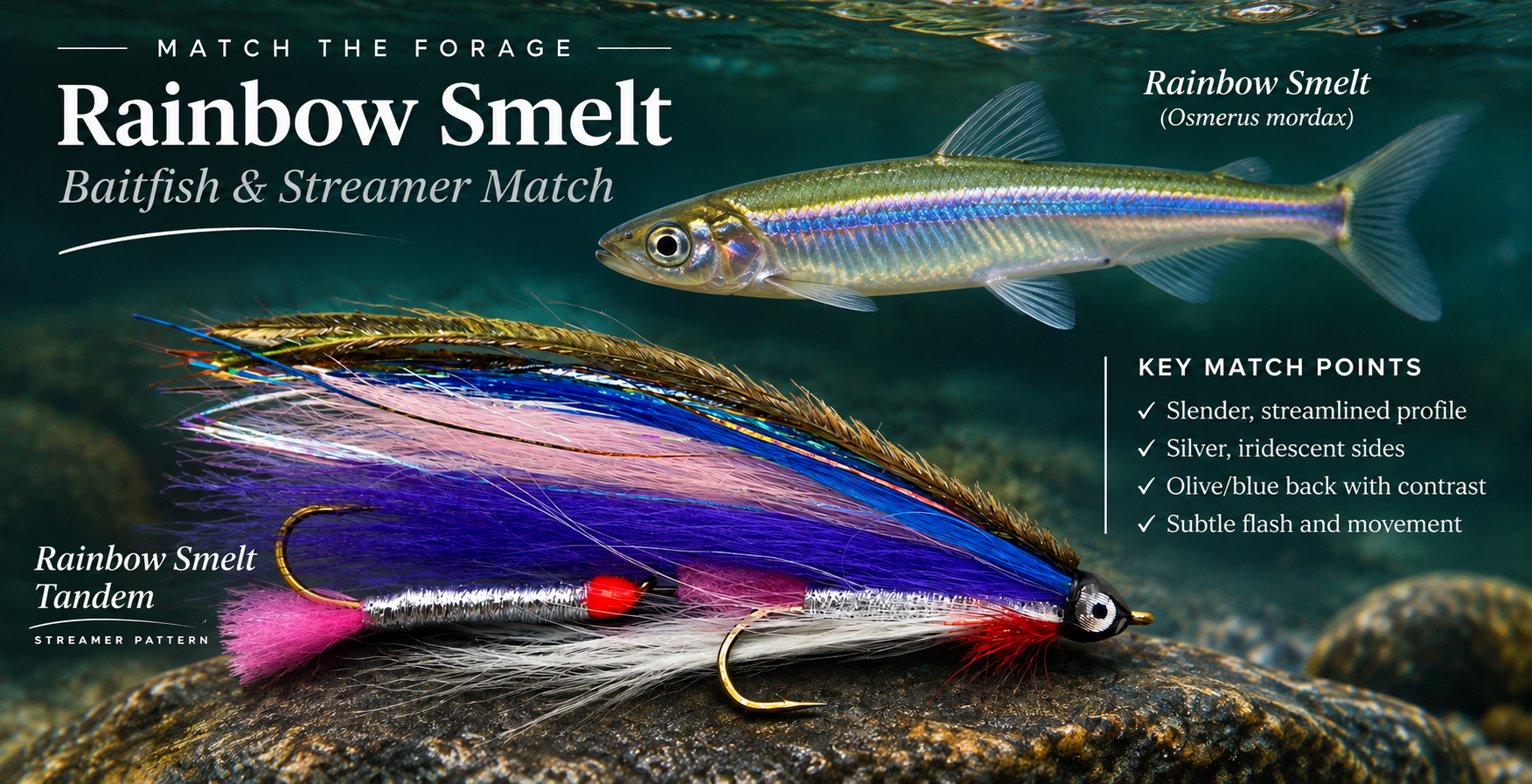
From forage to fly: The DcTackle Rainbow Smelt Tandem incorporates elements of the natural smelt's profile, iridescent coloration and reflective appearance.
Profile and Proportions
The rainbow smelt's long, relatively narrow body suggests a streamlined fly with a slender silhouette.
A bulky streamer may produce considerable movement, but it does not necessarily represent the proportions of a natural smelt.
The correct profile becomes particularly important when designing imitations intended to represent smaller forage fish.
Colour and Contrast
The natural smelt provides a useful colour palette:
-
Olive, grey or muted green along the back.
-
Silver or pearl along the sides.
-
White or pale silver along the belly.
-
Subtle blue, pink or purple iridescence.
These colours need not all appear in a single pattern. Depending on the available materials and intended fishing conditions, a simplified combination can effectively suggest the appearance of the natural fish.
Flash and Reflectivity
Smelt possess reflective scales that produce flashes of light as they turn and change direction.
A few strands of pearl or silver flash can help suggest this characteristic. Excessive flash, however, may create an appearance considerably brighter than the natural fish.
The objective is not necessarily to produce the brightest streamer, but to reproduce a convincing balance of light reflection, contrast and silhouette.
Movement and Presentation
Rainbow smelt are active swimmers. Their movement is generally consistent with a streamlined fish travelling through open water.
A streamer intended to imitate a healthy smelt should therefore be capable of maintaining a relatively narrow profile during retrieval.
Changes in retrieval speed, pauses and directional movement may help suggest a fish separating from a school or struggling to maintain its position.
These are practical presentation principles derived from smelt behaviour, not guarantees of how predators will respond.
9. Applying This Knowledge on the Water
Understanding rainbow smelt biology can help anglers make more informed decisions about where and how to fish streamers.
In freshwater lakes, locating suitable temperature zones and areas where schooling baitfish are present may be more productive than concentrating exclusively on shoreline structure.
In coastal environments, river mouths, estuarine transitions and areas influenced by tidal currents may provide opportunities to encounter migrating or feeding smelt.
Streamer size should reflect the likely size of local forage rather than assuming that all rainbow smelt are identical.
Smaller patterns may represent juvenile fish, while longer streamers can suggest mature individuals.
Most importantly, a smelt imitation is most relevant when there is reasonable evidence that smelt occur in the water being fished.
A pattern can be an excellent imitation of rainbow smelt and still be poorly matched to a particular lake or river.
Conclusion: Understanding the Forage Before Selecting the Fly
The rainbow smelt is an important component of Newfoundland and Labrador's aquatic ecosystems.
Its ability to occupy freshwater, estuarine and coastal habitats, combined with its schooling behaviour and seasonal movements, makes it an especially interesting forage species.
For brook trout and salmon anglers, understanding the smelt's biology provides useful context for selecting streamer sizes, colours, profiles and presentations.
For fly tyers, it demonstrates the value of designing patterns around identifiable characteristics of natural prey rather than relying exclusively on traditional colour combinations.
Ultimately, successful forage matching begins with a simple question:
What does the predator actually encounter in its natural environment?
The more accurately we can answer that question, the more purposeful our fly design and fishing decisions become.
Take Your Streamer Tying Further
Download Our Free Single-Hook Hairwing Streamer Guide
Interested in the materials, techniques and construction principles behind effective baitfish imitations?
Our free Single-Hook Hairwing Streamer Guide — Volume 1 explores the approach we use at the DcTackle tying bench, including streamer construction, material selection and practical tying considerations.
Whether you're developing your own patterns or refining your tying techniques, the guide provides a useful starting point.
Get Your Free Streamer Tying Guide -->
Sources and Further Reading
-
Government of Newfoundland and Labrador — Rainbow/American Smelt
https://www.gov.nl.ca/fal/wildlife/all-species/animals/inland-fish/rainbow-american-smelt/ -
Fisheries and Oceans Canada — Rainbow Smelt
https://waves-vagues.dfo-mpo.gc.ca/Library/329831.pdf -
Strong Water Stratification Provides a Refuge for Rainbow Smelt Larvae in Lake Melville, Labrador (2023)
https://www.sciencedirect.com/science/article/pii/S0272771423003438 -
Growth and Maturation of Rainbow Smelt at the Northern Limit of Their Distribution Range (2024)
https://online.ucpress.edu/elementa/article/12/1/00021/203974/Growth-and-maturation-of-rainbow-smelt-Osmerus -
Fisheries and Oceans Canada — Best Management Practices for Freshwater Fish Habitat in Newfoundland and Labrador
https://www.dfo-mpo.gc.ca/publications/pnw-ppe/nfl-freshwater-eaudouce-tnl/protection-eng.html
DcTackle & Outdoor Supply — Match the Forage Educational Series
Understanding the natural prey that influence streamer fly design, material selection and fishing applications.


